 Tiếng Việt
Chi tiết tin - Du khách

Cave of 100,000 Swallows
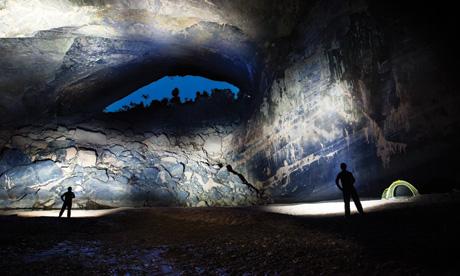
Nick Ross and Francis Roux took a grueling, two-day trip to Hang En, the cave of a hundred thousand swallows
When we set off to Hang En the day before, this was our goal: to reach a cave that has been featured in documentaries by the BBC and National Geographic. We had been told that short of a 7km potholing trip to the end of Paradise Cave and the big one, the six-day trip to Hang Son Doong, that this was the best caving excursion available. Yet at points during our first day’s trek it felt like madness. Why walk five hours through jungle, across rivers, and down a ravine known semi-affectionately by an English expletive just to reach a cave? Pain and duress for the sake of what? Going inside a cavern?
Little did we know
In fairness the 7km trek, while a recipe for sore limbs and aching bones, was exhilarating. When you pass by the mountains and jungles of Vietnam, stare at the peaks above and the valleys below, there is an intrigue. What is inside? What’s it like in this impenetrable mass of trees, undergrowth and limestone rock?
Now we were inside. Now we had passed through an isolated, untouristed ethnic minority village. And at points the soaring views and the forever changing terrain were quite beautiful. It’s a beauty that you can only experience by being there, but well-compositioned photos and well-crafted words can at least help you get a sense of it.
The Beach
It’s gone 6.15am and two of us are on an early breakfast of Berocca and three-in-one coffee. The porters — a word that invokes images of khaki-clad colonials trekking through Africa — are at work preparing the first, early morning event. On the makeshift fire, hand-cut chips are sizzling in a pan. Fried noodles are on the menu for when we come back from exploring the rest of the cave, but for now it’s still early and four of our group of seven still sleep in their one-man tents.
Everything we have here has been hand-carried in red waterproof backpacks — these 50kg backpacks have been through the searing tropical sun and its unforgiving heat. The porters don’t break a sweat. They are faster than us, too. Scrambling up and down rocks, wading through the river, they are sure of foot, hardy, jungle-trained from birth. The night before they pitched our tents on a beach inside the main cavern, and for dinner they cooked us a meal of barbecued pork, tofu in tomato sauce, stir-fried beef with pineapple, omelette and cabbage broth. Now, again, they are on breakfast.
6.30am. The light is seeping through the cave entrance, 100m above. “It’s not every day that you wake up in a cave,” says one of our group, stretching his arms before heading to the river to wash his face and collect his drying clothes.
Only a few minutes before, the cave had that pale blue luminance of fluorescent light. Now an orange glow has fed into the colour mix. From the National Geographic photos, the ones that hit the world in early 2011, we thought that the cave entrance was at ground level. While visually awe-inspiring — the greens of the forest mixed in with the greys and beige of the rock formations — it feels like it was misrepresented.
Now in the cave we think we can see how those photos were taken. The photographer scrambled up the rocks on the far end of the 80 metre-high cavern, while his model climbed the rocks to the cave entrance. The idea was to give a sense of size, a perception of scale. The tiny human stood in the entrance, while around him loomed the Mars-like, extraterrestrial majesty of the caves.
Each photo on that expedition, which started at Hang En before going into Son Doong, took four-and-a-half hours to set up and used US$2,500 of lighting equipment. The photos and the expedition finally put the previously untapped Phong Nha on the international map.

Men on Mars
An hour has passed, toilet break has been made, and chips, fruit and Vietnamese packaged cake snacks have been eaten to get up the energy levels. Still the birds frolic, tweet and socialise way up above. We prepare to explore the cave.
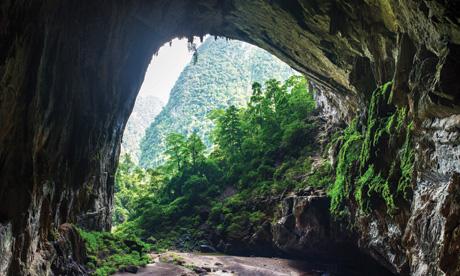
Once again we cross the river, but this time we head in the opposite direction, away from the original entrance. Scrambling up rocks, the limestone seems to change colour, from blue to purple to a deep green. Then, as we clamber over some more boulders, a new sight hits our faces. From another entrance light streams in, shadowed by jungle-covered mountains behind. Below emerges the river, surrounded by another muddy beach, while beyond is an unearthly landscape, the kind you see in sci-fi movies. Words in the English language — indeed in any language — just cannot describe it.
This is what we came here for — not just to see the caves, but to experience what a lack of sunlight, rock formations created over millions of years and what that beast called nature can do to an underground landscape. It’s like diving in the sea. Once you go below the surface you enter another world. But here the world is a concoction of land, rock and fresh water, the three merging to create strange shapes, unfamiliar forms that you might expect to find on Mars.
Once again we try to take photos, try to put the scale and the magnitude of the place inside the cocoon of a lens. As we prepare the setup — the tiny figure caught from afar — I see vines hanging from various parts of the cave walls and ask our guide, Thin, what they are for.
“They were put there by the locals, by the ethnic minorities in the park,” he explains. “They climb up there for birds’ nests and eggs.”
“With no safety ropes?” The cave walls are sheer, at a 90-degree angle from the base below.
“With no safety ropes.”
He picks up a handful of the droppings covering the rocks. “They collect this for fertiliser,” he adds.
The End of the Road
Later that day as we sit on the bus leaving the area, our group reflects on what we had just experienced. There was the old man and owl in the ethnic minority village, the jungle honey they sold us by the litre, the bananas and the intrigued kids. There was the final climb at terrible hill that had most of us in a state of physical despair. There was the night before, drinking hand-carried rice wine in the cave. There was the river that we forded again and again on our trek to Hang En, the same river that then goes onto Son Doong. There were the porters, the leeches, the photos we all took.
So many things. So many memories. And with it came the realisation of where we’d just been.
Hang En, one of the natural wonders of the world.
And we hadn’t even ventured into Son Doong, the cave making all the headlines. As speleologist Howard Limbert says, “Hang En is the biggest wow factor in Vietnam on a reasonable price scale.”
Source: World Vietnam
- The Largest Cave in the World (02/10/2014)
- Photo by Simon Dunne Ho Khanh’s discovery of Son Doong is the stuff of legend. As a young man searching for timber, he was caught in a tropical storm. He took cover in the mouth of a cave. Entering the grotto he discovered a cavern so huge that he was overwhelmed. Years later he tried to rediscover the spot. In 2008, on his second attempt, he found the entrance and went inside. A few months on he came back with British speleologist Howard Limbert and a British cave exploration team. In August of this year, Khanh and Howard led the first tourist expedition to Son Doong. The seven-day trek took six tourists into the confines of the world’s largest cave, supported by a team of 23 porters and guides. The trip cost US$3,000 (VND63 million) per person, which paid for three nights sleeping in the cave. Says Howard, “Many people wanted to open up Son Doong for mass tourism. But eventually a proposal was accepted to take through 84 people a year.” The tours run twice a month from February to August Photo by Vietnam Caving Expedition The Land of Dinosaurs Containing the tallest stalagmite in the world — the formation is 80m high — the cave is home to 300 million-year-old fossils, while one section, known as The Wall of Vietnam, is over 200m high. “Some of the skylights are 200m to 250m high,” adds Howard. “The addition of light creates a small jungle in the cave.” One such jungle area has been named The Garden of Eden. So big are these mammoth, sunlit caverns that, as journalist Mark Jenkins wrote in the National Geographic, there is “room enough for an entire New York City block of 40-story buildings. There are actually wispy clouds up near the ceiling.” A member of the exploration team in 2009, he adds, “The tableau could have been created by an artist imagining how the world looked millions of years ago.” Ben Mitchell was one of the six tourists. “Going to Son Doong was life-changing,” he said. “When I was a kid I saw Mount Everest and later on went to Maasai Mara in Kenya. It was better than the two of them put together.” Despite the price, the tours are proving popular — they are already fully booked until well into next year. And no wonder. Son Doong is spectacular. Source: World Vietnam (02/10/2014)
- Báo Mỹ hết lời ca ngợi hang Sơn Đoòng của Việt Nam (19/09/2013)
- Bản Tà Vờng: Điểm du lịch độc đáo (16/09/2013)
- Tiềm năng phát triển du lịch hang động (16/09/2013)
- Du lịch Anh mở tour khám phá hang Sơn Đoòng (16/09/2013)
- Phong Nha: Ten years like a dream! (02/10/2014)
- Discovering Chay River and Toi Cave (02/10/2014)
- Inside the world's largest cave (13/09/2013)
- Paradise Cave in Quang Binh (02/10/2014)


