 Tiếng Việt
Chi tiết tin - Du khách

The Tu Lan Experience
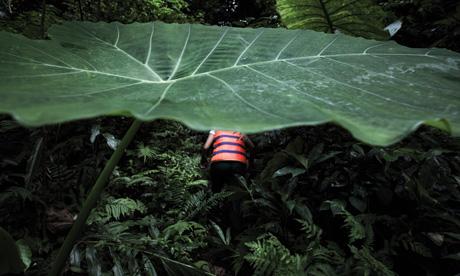
Two river caves 40km from Phong Nha provided Marc Forster-Pert
with an adrenalin-fuelled mix of adventure and picture postcard scenery. Photos by Francis Roux
But those seeking an adventure have to look a little further afield. A tour to the Tu Lan cave system may well be the antidote. The good news? There aren’t busloads of tourists. The concrete road linking the Ho Chi Minh Highway to the tour starting point in Yen Thu village hasn’t even been completed.
The Adventure Begins
Dodging the road workers, we walked a short distance to meet our ride to take us to the starting point — the vehicle, a repurposed US army jeep. We could have been making a sequel to Indiana Jones, heading off into the jungle as the jeep bumped and jolted its way along a dirt track past mud-grazing buffalo to the rendezvous point. Equipped with life jackets, Cambodian army boots, a helmet and a head torch, we set off looking more like coal miners than explorers.
The first task was to traverse the gentle Rao Nan River, usually crossable by foot. Reaching the bank, the picture was far from gentle. Unseasonable rains had allowed the water to rise and the current to gain momentum. Looking at the others, I could see I wasn’t the only one a little daunted by the prospect of swimming across — thank goodness for the life jackets. A deep breath taken and a leap into the bracing river, adrenalin coursing every vein. Swimming hard to reach the opposite bank, the current took us 150m downstream.
Out of of breath, we climbed up over a ridge and into a valley surrounded by the limestone karsts that characterise the landscape. Blanketed by thick jungle, they created a scene so peaceful and spectacular, it was hard to believe this place exists, such was its majesty. It felt lagoon-like, a scene reminiscent of those from The Beach, the water being replaced by thick scrub where butterflies leapt and jumped. A barely recognisable path charted the way to the entrance of the first cave, Hung Ton.
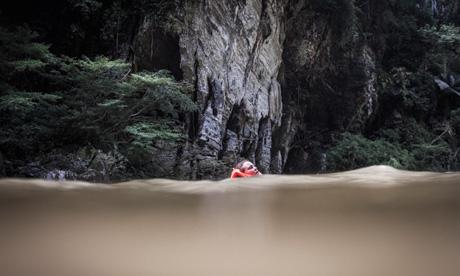
Darkness
There’s no danger of claustrophobia inside the enormous cavern even though it isn’t long before daylight is exchanged for complete darkness, only intercepted by a flash of a light. Reminding myself this wasn’t a dream, we walked through the cave admiring the church organ-like stalagmites and stalactites that have formed over thousands of years.
It was then time to repack the dry bag for the next swim, this time, inside the cave. Billed as moderate, swimming wasn’t actually necessary as the strong current carried us towards the waterfall out of the cave mouth. Stopping just short, we climbed out through another exit into the forest and through to the lagoon below.
The itinerary would have us visit Kim Cave, named after the Dutch tourist that discovered it after a call of nature on a jungle trek in 2009. Swimmable when the water level is lower and the current not so ferocious, Dzung, our guide, made the decision not to venture in. The decision was vindicated when bathers inside the lagoon were sent tens of metres in a few seconds by the force of the waterfall.
Plan B was to trek back through the jungle to visit Rat Cave or Hang Chuot, no mean feat as it required traversing a steep karst ridge. Slippery from the rains, a couple of tour members lost their footing, including our very own editor.
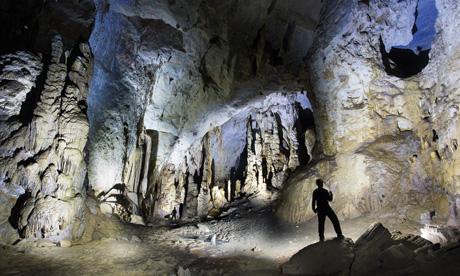
A Feeling of Euphoria
Finally inside, tired and drenched in muddy sweat, we were met by a deafening silence. Despite many people having already charted this course, looking up at this magical arena it was hard not to feel intrepid and believe we were just discovering this remarkable feat of Mother Nature for the first time. It felt euphoric.
After another river crossing completed, we were left exhausted, sipping cold cans of beer and soft drink. The tour was sadly over for us but thankfully it won’t be for the local villagers.
Oxalis employs 30 people locally, including our 21-year-old porter, Trung. It serves to strengthen the local economy and make earning an illegal living through logging or hunting less tempting. Real change will only be possible through more tour companies coming in to sustain growth, and continuing to provide jobs and protect the landscape.
They’re creating passion, too. Dzung, our guide, is someone who lives and breathes his work: “I love my job because I love the jungle. I love the caves, I love adventure and most of all we can give a helping hand to protect the environment for the next generation to enjoy.” Enjoyable was an understatement. Epic, maybe?
Source: World Vietnam
- Cave of 100,000 Swallows (02/10/2014)
- The Largest Cave in the World (02/10/2014)
- Photo by Simon Dunne Ho Khanh’s discovery of Son Doong is the stuff of legend. As a young man searching for timber, he was caught in a tropical storm. He took cover in the mouth of a cave. Entering the grotto he discovered a cavern so huge that he was overwhelmed. Years later he tried to rediscover the spot. In 2008, on his second attempt, he found the entrance and went inside. A few months on he came back with British speleologist Howard Limbert and a British cave exploration team. In August of this year, Khanh and Howard led the first tourist expedition to Son Doong. The seven-day trek took six tourists into the confines of the world’s largest cave, supported by a team of 23 porters and guides. The trip cost US$3,000 (VND63 million) per person, which paid for three nights sleeping in the cave. Says Howard, “Many people wanted to open up Son Doong for mass tourism. But eventually a proposal was accepted to take through 84 people a year.” The tours run twice a month from February to August Photo by Vietnam Caving Expedition The Land of Dinosaurs Containing the tallest stalagmite in the world — the formation is 80m high — the cave is home to 300 million-year-old fossils, while one section, known as The Wall of Vietnam, is over 200m high. “Some of the skylights are 200m to 250m high,” adds Howard. “The addition of light creates a small jungle in the cave.” One such jungle area has been named The Garden of Eden. So big are these mammoth, sunlit caverns that, as journalist Mark Jenkins wrote in the National Geographic, there is “room enough for an entire New York City block of 40-story buildings. There are actually wispy clouds up near the ceiling.” A member of the exploration team in 2009, he adds, “The tableau could have been created by an artist imagining how the world looked millions of years ago.” Ben Mitchell was one of the six tourists. “Going to Son Doong was life-changing,” he said. “When I was a kid I saw Mount Everest and later on went to Maasai Mara in Kenya. It was better than the two of them put together.” Despite the price, the tours are proving popular — they are already fully booked until well into next year. And no wonder. Son Doong is spectacular. Source: World Vietnam (02/10/2014)
- Báo Mỹ hết lời ca ngợi hang Sơn Đoòng của Việt Nam (19/09/2013)
- Bản Tà Vờng: Điểm du lịch độc đáo (16/09/2013)
- Tiềm năng phát triển du lịch hang động (16/09/2013)
- Du lịch Anh mở tour khám phá hang Sơn Đoòng (16/09/2013)
- Phong Nha: Ten years like a dream! (02/10/2014)
- Discovering Chay River and Toi Cave (02/10/2014)
- Inside the world's largest cave (13/09/2013)


