 Tiếng Việt
Chi tiết tin - Du khách

Paradise Found
“What do you mean?”
“The golf buggies,” he explains. “You know how they were driven through the jungle? It’s kind of the same here, just without the dinosaurs.”
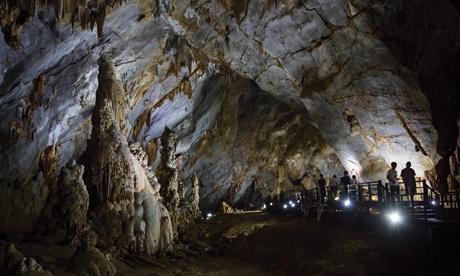
A trip to Phong Nha is more than just caves. It’s a trip to another world. Words by Nick Ross. Photos by Francis Roux
We’re at the base of the mountain that leads to the entrance of Paradise Cave, or Hang Vom, a site claimed by the Vietnamese press to be one of the most impressive in the country. With a quorum of notable destinations already on the list, this is quite an accolade.
Following Ben’s suggestion, when we descend from the golf buggy, we take the ramp to the right 500m up to the cave entrance rather than the steps. It is good advice. While exploring the well mapped-out, manicured interior of the cave isn’t tough work, the steps would have made us breathless even before entering the cavern.
We are on the first of a five-day trip to Phong Nha, and Ben is guiding us around the park in his pickup. One of a small number of people who lives and breathes Phong Nha — together with his wife Bich he runs Phong Nha Farmstay, the first western-run guest house in the area — his local knowledge is matched by his passion. Like other zealous individuals we meet on our trip, both Vietnamese and foreign, Ben is the park.
Paradise Cave is surprising. All in our group are used to the lack of organisation and the lack of care taken over some of Vietnam’s most beautiful spots. Hong Chong, on the southern edge of the Mekong Delta, comes to mind. Described once as the Halong Bay of the south, a cave pagoda leads out onto a sandy bay with limestone karsts peaking out from the sea. But instead of providing a spiritual experience, a pilgrimage, the beach is dirty. Tourists on the road leading to the pagoda are accosted by beggars and stallholders pedaling their wares.
Here it is different. Litter bins are at every 20m, with signs encouraging tourists to put their waste in the appropriate places. Additional encouragement along the lines of ‘Rung la vang’, or ‘the jungle is gold’, appears intermittently along the trails to and from the caves. And anyone who steps outside the wooden walkways of the cave is tasered by security. A harsh response, perhaps, but with the unruliness of almost 2,000 tourists a day in high season, a necessary preventative measure.
Above and Below
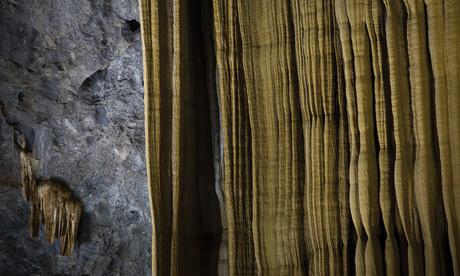
Descending the dimly-lit steps into the cave a cavern opens out before us. Our guide explains the difference between stalagmites and stalactites — the latter come down from the cave roof — and adds that we shouldn’t touch them. If we do, she says, it may prevent further growth. In the caves in Halong Bay, such instructions are never given, and if they are, they are ignored.
At the bottom the steps open out into a wooden walkway. Five years ago I visited Phong Nha Cave, once the only accessible spot in the park. Taking what was then a not-so-popular day trip from Hue, on arrival we took a boat down the Son River before entering the main grotto. Multi-coloured lights lit up the rock formations, the noise of boatloads of tourists echoed through the corridors, and — while a pleasant trip — as I left I found myself more fascinated by the surrounding mountains and jungle than what lay inside.
Paradise Cave also has the lighting, but without the multi-coloured, disco-like display. And as you wander past the grottoes, the rock formations and through corridors both large and small, you gradually become aware of this cave’s beauty and of the world-class setup. The management, the tour guides, the security, the wooden walkways, the signage and even the golf buggies. No wonder it has received such local accolades. Paradise Cave would work anywhere in the world.
More to Come
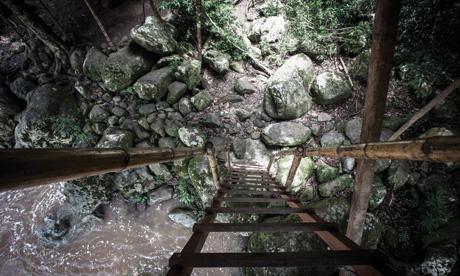
Our drive to Paradise Cave is punctuated by a walk on the Nuoc Mooc Nature Trail — the water levels are too high for us to follow the whole trek — and by Ben’s constant explanation of the ins and outs of Phong Nha.
He seems to have a knowledge about the area few can surpass. From the former airstrip now transformed into a road, to the crossroads at Tra An Bridge that formed a major intersection along the former Ho Chi Minh Trail, to the cliff face that was constantly bombed to close the pass along which diesel supplies were carried by the Viet Minh.
As we gradually head back to Ben’s farmstay, our excitement grows. The next day we are taking a one-day trek through two river caves in the Tu Lan cave system, on the edge of but just outside the national park. And on the Sunday, two of us will be tackling Hang En, the cave that was featured in National Geographic alongside Hang Son Doong, the largest cave in the world.
Compared to when I was here five years ago — to quote a cliché — it is like being on a different planet. All that forest and karst that I spied is now opening up, and new caves, it seems, are discovered by the week. The park has three cave systems — Phong Nha, Vom and Nuoc Mooc — of which the latter is as of yet completely unexplored. And speleologists believe there may even be bigger caves out there than Son Doong.
Which means that the tourist possibilities — for both the easy and the more difficult trips — are endless. Just don’t bring in the cable car.
Source: World Vietnam
- The Tu Lan Experience (02/10/2014)
- Cave of 100,000 Swallows (02/10/2014)
- The Largest Cave in the World (02/10/2014)
- Photo by Simon Dunne Ho Khanh’s discovery of Son Doong is the stuff of legend. As a young man searching for timber, he was caught in a tropical storm. He took cover in the mouth of a cave. Entering the grotto he discovered a cavern so huge that he was overwhelmed. Years later he tried to rediscover the spot. In 2008, on his second attempt, he found the entrance and went inside. A few months on he came back with British speleologist Howard Limbert and a British cave exploration team. In August of this year, Khanh and Howard led the first tourist expedition to Son Doong. The seven-day trek took six tourists into the confines of the world’s largest cave, supported by a team of 23 porters and guides. The trip cost US$3,000 (VND63 million) per person, which paid for three nights sleeping in the cave. Says Howard, “Many people wanted to open up Son Doong for mass tourism. But eventually a proposal was accepted to take through 84 people a year.” The tours run twice a month from February to August Photo by Vietnam Caving Expedition The Land of Dinosaurs Containing the tallest stalagmite in the world — the formation is 80m high — the cave is home to 300 million-year-old fossils, while one section, known as The Wall of Vietnam, is over 200m high. “Some of the skylights are 200m to 250m high,” adds Howard. “The addition of light creates a small jungle in the cave.” One such jungle area has been named The Garden of Eden. So big are these mammoth, sunlit caverns that, as journalist Mark Jenkins wrote in the National Geographic, there is “room enough for an entire New York City block of 40-story buildings. There are actually wispy clouds up near the ceiling.” A member of the exploration team in 2009, he adds, “The tableau could have been created by an artist imagining how the world looked millions of years ago.” Ben Mitchell was one of the six tourists. “Going to Son Doong was life-changing,” he said. “When I was a kid I saw Mount Everest and later on went to Maasai Mara in Kenya. It was better than the two of them put together.” Despite the price, the tours are proving popular — they are already fully booked until well into next year. And no wonder. Son Doong is spectacular. Source: World Vietnam (02/10/2014)
- Báo Mỹ hết lời ca ngợi hang Sơn Đoòng của Việt Nam (19/09/2013)
- Bản Tà Vờng: Điểm du lịch độc đáo (16/09/2013)
- Tiềm năng phát triển du lịch hang động (16/09/2013)
- Du lịch Anh mở tour khám phá hang Sơn Đoòng (16/09/2013)
- Phong Nha: Ten years like a dream! (02/10/2014)
- Discovering Chay River and Toi Cave (02/10/2014)


