 Tiếng Việt
Chi tiết tin - Du khách

A four-hour tour of the Chay river and Toi cave
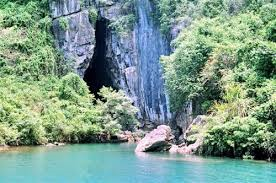
Gate of Dark Cave on Chay River
The trip starts from the wharf at Tro Mong Forest Management Station in Phuc Trach commune, Bo Trach district. Rowing on the 10km-long Chay river which originates from the immense mountains in the ancient karst mountain area of Phong Nha-Ke Bang, tourists seem to be on a lissome silk ribbon with two sides of verdant fields of corn and old trees.
During the trip, tourists sometimes see stones in different shapes in the clear and turquoise water of the river. The blue colour of the water in this river is rather strange and according to scientists’ explanation it is because of the erosion of the karst mountains and the natural phenomenon of calcium dissolving into water for millions of years.
Rowing the kayak on the transparent Chay river, tourists arrive at the entrance to Toi cave where the temperature is quite lower than the outside. Toi cave, with a length of 5,258m and a height of 80m, is a branch of the system of Phong Nha caves (a cave of the Phong Nha system) which was surveyed by explorers from the British Caving Association in 1990 and 1992.
Going deep inside the cave, tourists will enjoy cool air and the magnificent beauty of the stalactites and stalagmites in different shapes on the ceiling and the floor that look like a golden stream. The stalactites in the cave are considered the standard sample of fossils that help scientists define the origination of the ancient karst mountains in Phong Nha-Ke Bang from the ancient ocean.
Because it is located near the river, the cave is rather humid, creating favourable conditions for the growth of fern plants. Therefore, tourists sometimes see small fern plants growing on stalactites and stalagmites that is a new and strange natural phenomenon in Toi cave. The cave is also home to many animals like bats, swallows and Vooc (trachypithecus phayrei crepusculus). In 1995 Russian scientist L.Deharveng discovered a new species of crab and named it nemoron nomas. The sample of this species of crab is now preserved at the National University of Singapore’s Museum.
Taking in the four-hour tour, tourists not only had a chance to discover the beauty of nature, but also accumulate useful knowledge about typical karst geomorphologic characteristics of the ranges of mountains and diversified ecological system in Vietnam.
Source: VNA
- Paradise Found (02/10/2014)
- The Tu Lan Experience (02/10/2014)
- Cave of 100,000 Swallows (02/10/2014)
- The Largest Cave in the World (02/10/2014)
- Photo by Simon Dunne Ho Khanh’s discovery of Son Doong is the stuff of legend. As a young man searching for timber, he was caught in a tropical storm. He took cover in the mouth of a cave. Entering the grotto he discovered a cavern so huge that he was overwhelmed. Years later he tried to rediscover the spot. In 2008, on his second attempt, he found the entrance and went inside. A few months on he came back with British speleologist Howard Limbert and a British cave exploration team. In August of this year, Khanh and Howard led the first tourist expedition to Son Doong. The seven-day trek took six tourists into the confines of the world’s largest cave, supported by a team of 23 porters and guides. The trip cost US$3,000 (VND63 million) per person, which paid for three nights sleeping in the cave. Says Howard, “Many people wanted to open up Son Doong for mass tourism. But eventually a proposal was accepted to take through 84 people a year.” The tours run twice a month from February to August Photo by Vietnam Caving Expedition The Land of Dinosaurs Containing the tallest stalagmite in the world — the formation is 80m high — the cave is home to 300 million-year-old fossils, while one section, known as The Wall of Vietnam, is over 200m high. “Some of the skylights are 200m to 250m high,” adds Howard. “The addition of light creates a small jungle in the cave.” One such jungle area has been named The Garden of Eden. So big are these mammoth, sunlit caverns that, as journalist Mark Jenkins wrote in the National Geographic, there is “room enough for an entire New York City block of 40-story buildings. There are actually wispy clouds up near the ceiling.” A member of the exploration team in 2009, he adds, “The tableau could have been created by an artist imagining how the world looked millions of years ago.” Ben Mitchell was one of the six tourists. “Going to Son Doong was life-changing,” he said. “When I was a kid I saw Mount Everest and later on went to Maasai Mara in Kenya. It was better than the two of them put together.” Despite the price, the tours are proving popular — they are already fully booked until well into next year. And no wonder. Son Doong is spectacular. Source: World Vietnam (02/10/2014)
- Báo Mỹ hết lời ca ngợi hang Sơn Đoòng của Việt Nam (19/09/2013)
- Bản Tà Vờng: Điểm du lịch độc đáo (16/09/2013)
- Tiềm năng phát triển du lịch hang động (16/09/2013)
- Du lịch Anh mở tour khám phá hang Sơn Đoòng (16/09/2013)
- Phong Nha: Ten years like a dream! (02/10/2014)


